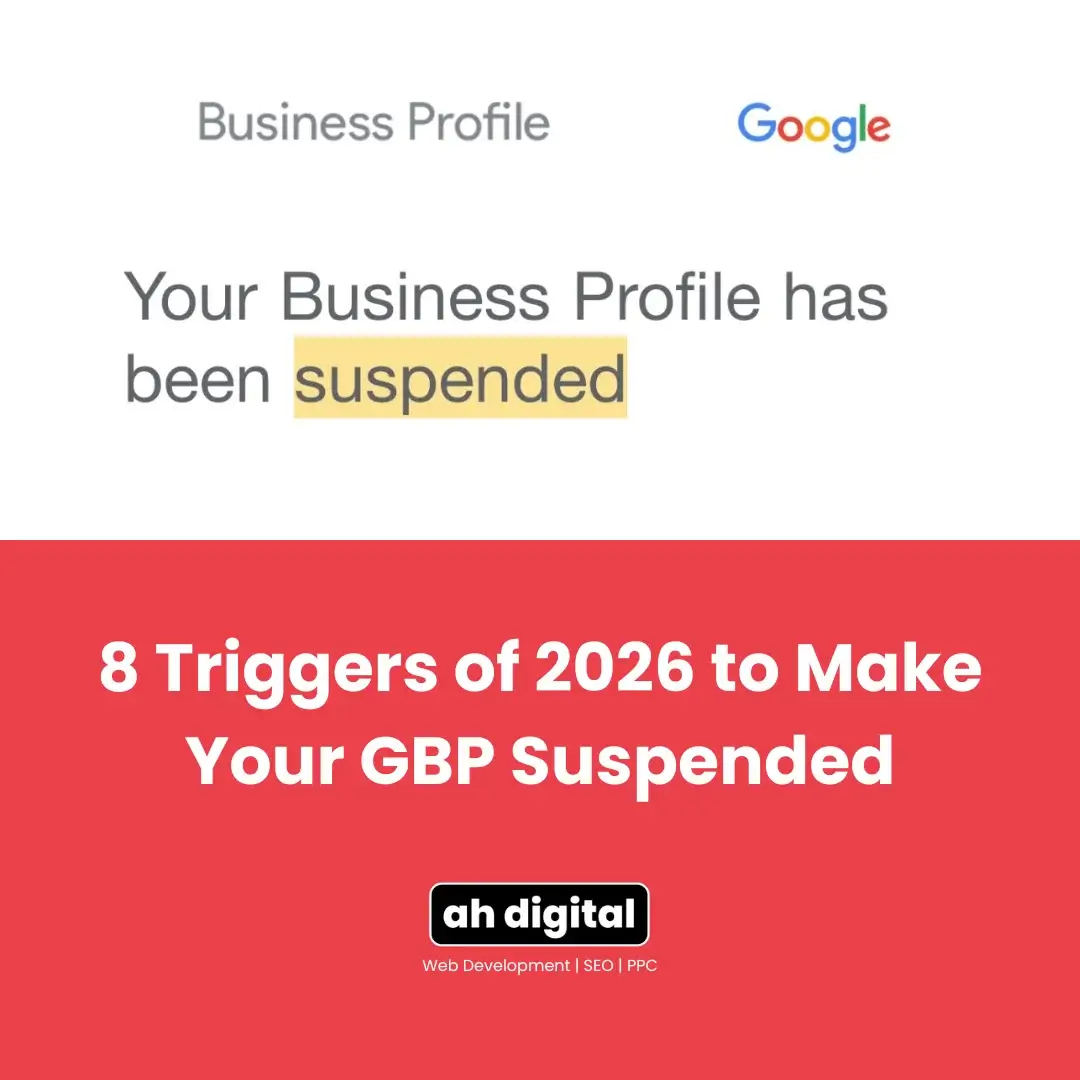
Client: “We didn’t change anything. It just got suspended.”
Something usually did trigger it. Owners just don’t know which of a specific, checkable list of 8 things to look at.
This is the detailed companion to our full reinstatement guide: the exact 8 triggers behind most 2026 suspensions, plain language, with the fix for each. Work through this list against your own profile before you do anything else.
Google’s automated review system checks a fixed set of signals, not a mood or a gut feeling. That’s actually good news: it means the cause is almost always one of a known, limited list, not something arbitrary or unfixable. You just need to know what to check.
The 8 Triggers Behind Most GBP Suspensions
1. Keyword-stuffed business name. This is the single most common trigger going into 2026. Something like “Best Real Estate Agency Dubai 24/7” instead of your actual registered name. Your profile name must match your real-world signage and trade licence exactly. Fix: strip the name back to what’s on your licence and signboard, nothing added.
2. NAP mismatch across your website and directories. Roughly 40 percent of suspensions trace back to this, and even small differences like “St” versus “Street” count as a mismatch. The mismatch doesn’t have to be dramatic to matter, an old phone number sitting on one directory listing is enough on its own. Fix: audit every place your name, address, and phone number appear and make them identical everywhere.
3. Wrong or over-broad category. Choosing a category that doesn’t accurately describe your business, just to appear in more searches, is a guideline violation, not a growth hack. Switching between a storefront category and a service-area category without actually changing how the business operates raises the same flag. Fix: pick the single most specific, accurate category available, not the broadest one that technically fits.
4. Too many edits at once. Changing your name, address, phone number, and category all in the same session raises suspicion, since real businesses don’t normally update all of that at once. This one catches out owners doing a well-intentioned “spring clean” of their profile, updating everything they’ve been putting off in a single sitting is exactly the pattern that reads as suspicious. Fix: space out significant edits, and only change what actually needs changing.
5. PO box or virtual address. A PO Box, UPS Box, or unstaffed virtual office is enough on its own to trigger suspension, a real case from Google’s own community forum shows exactly this happening. Coworking desks and mail centers don’t qualify either unless you have genuine, staffed, permanent space. Fix: use a real, staffed address, or set up correctly as a service-area business if you don’t have one.
6. Duplicate listings. A second listing for the same business, often created after a sudden change like a rebrand or address move, is one of the most common suspension triggers tied to profile actions. The instinct to create a fresh listing after a problem is usually exactly the wrong move, it multiplies the same risk instead of resolving it. Fix: merge or remove duplicates rather than letting two listings compete for the same business.
7. High-spam industry categories. Categories like locksmiths and garage door services get flagged more heavily simply because those industries attract a disproportionate amount of fake and spam listings. Businesses in these categories should expect closer automated scrutiny by default, not as a penalty, just as the baseline. Fix: if you’re in one of these categories, keep every other detail extra clean, since you have less margin for error than most.
8. Shared account access from multiple devices. Unusual login patterns, logging in from several unrecognized devices or locations, can trigger a protective suspension meant to catch unauthorized access. This is the same access confusion that causes ownership disputes down the line, several people with login details, nobody sure who’s actually supposed to have them. Fix: audit who has access regularly, and remove anyone who no longer needs it.
Which of These Triggers Is Most Common in the UAE?
Real estate and home-services listings see triggers #1 and #7 together more than most categories here. “Best Villa Rentals Dubai” style names combine with categories Google already treats as higher spam risk, a compounding effect that makes an otherwise minor naming habit far riskier than it would be in a lower-scrutiny category.
Trigger #5 shows up disproportionately often in the UAE too. Free-zone business culture leans heavily on flexi-desks and virtual offices for legitimate reasons, company formation, cost, flexibility, but Google’s verification systems don’t make exceptions for that. If your registered address isn’t a staffed physical space, this is worth checking first. If you’re a service-area business by nature, cleaning, maintenance, mobile repair, the fix isn’t finding a staffed office, it’s setting the profile up correctly as a service-area business so an address was never required in the first place.
Trigger #2 deserves a second mention here as well. UAE businesses commonly operate across two languages, Arabic and English signage, and a legal trade licence name that reads differently from either. That’s three versions of the same business name in circulation before you’ve even touched a directory listing, exactly the kind of drift that produces a NAP mismatch without anyone intending it.
Can More Than One of These Triggers Apply at Once?
Yes, and it’s common. A keyword-stuffed name paired with a virtual address is a frequent combination, since both often come from the same instinct: trying to look bigger or rank better through the listing itself rather than the actual business behind it.
Reviewing every field on the profile at once, name, address, category, hours, website link, rather than checking one thing and stopping, is what actually catches a stacked set of triggers. Owners who fix the first obvious issue and assume that’s the whole problem are the ones who see a second suspension shortly after the first appeal succeeds.
Work through all 8 against your profile, not just the first one that seems to match. Fixing one trigger while another sits untouched still leaves you exposed.
I Fixed the Trigger, Now What?
Identifying and fixing the trigger is step one, not the finish line. You still need to submit a clean, evidence-backed appeal, our full reinstatement guide walks through reading the suspension notice properly, gathering documentation, and submitting one clean appeal via business.google.com.
Simple, well-documented cases typically resolve within 3 to 7 days. More complex cases involving disputed addresses or multiple listings can take 2 to 6 weeks, another reason to fix the actual trigger before appealing rather than guessing.
Submitting an appeal before actually fixing the trigger is one of the most common ways to waste that first attempt. Reviewers check whether the underlying issue is resolved, not just whether you’ve asked nicely. Fix first, document the fix, then appeal, in that order, every time.
The Takeaway
Eight specific, checkable causes, not a vague policy mystery. Most suspensions trace back to one or two of them, rarely something unexplainable.
Run through this list once now, even if your profile hasn’t been suspended yet. Catching a keyword-stuffed name or a stale directory listing before Google’s automated review flags it costs you ten minutes. Catching it after suspension costs you days of lost visibility and calls.
Eight causes. One audit. Check them all before you appeal.
If you’d rather have someone experienced audit your profile against all 8 and handle the appeal for you, AH Digital’s GBP management services in Dubai cover exactly this. We also run the SEO and Google Ads side of lead generation, the combination behind results like a 4,200 percent increase in lead form submissions for past clients. Fill in the quick form, WhatsApp us, or call +971 56 544 6241 directly.