There is one question during Google Business Profile setup that decides more about your profile’s survival than anything else you fill in.
“Do customers visit your business address?”
Most owners answer it in about two seconds, pick whichever sounds more established, and move on. That answer determines whether your address displays publicly, what your verification video needs to show, and whether you are quietly in breach of Google’s guidelines from day one.
Getting it wrong is one of the most common reasons UAE businesses end up suspended. Here is how to choose correctly.
The Three Options Google Offers
Storefront
A storefront serves customers in person, at a physical location, during stated opening hours. Google’s definition centres on a public-facing location with permanent on-site signage where customers are received.
Restaurants, clinics, salons, retail shops, showrooms. Somewhere a customer can walk in.
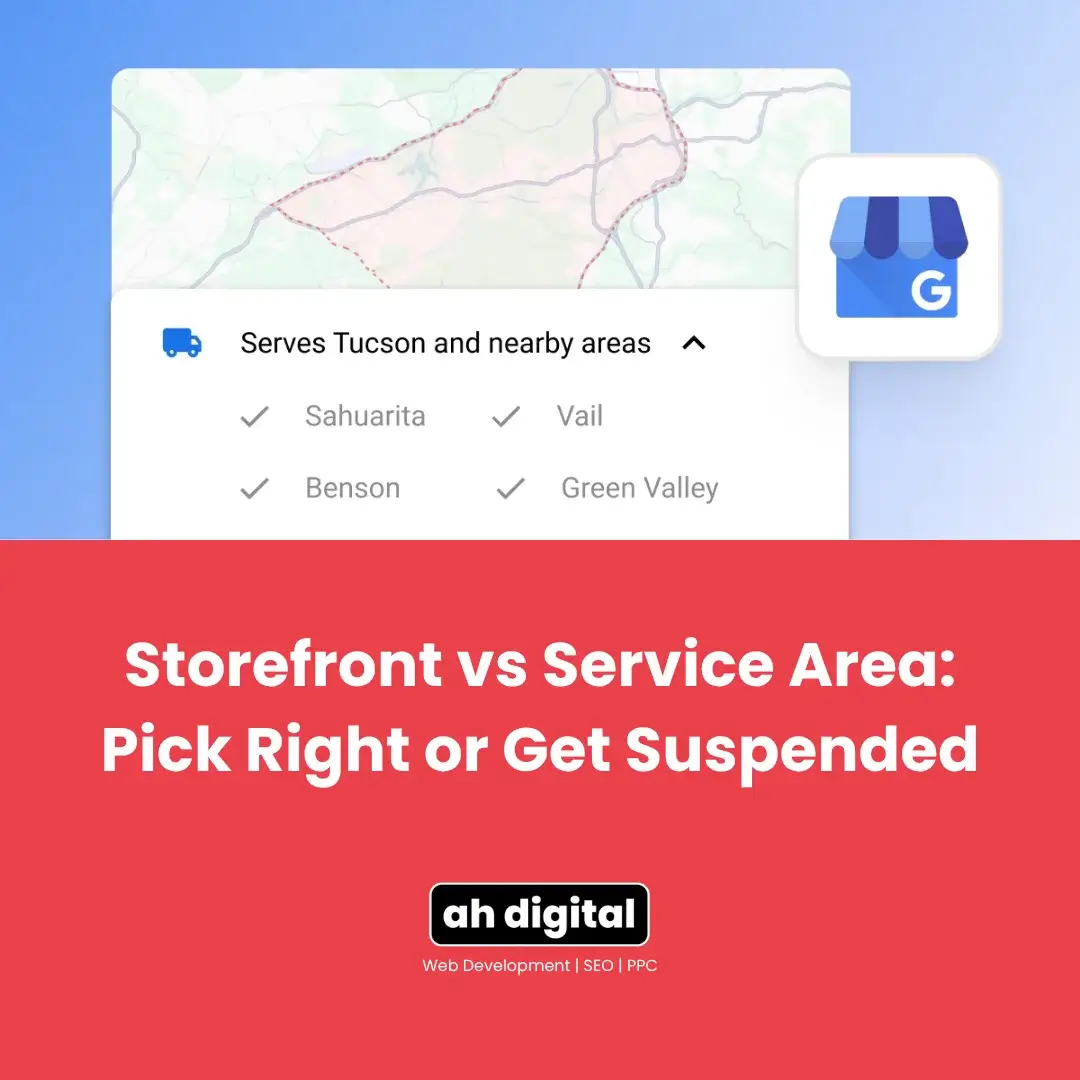
Service Area
A service area business goes to the customer instead. It delivers goods or services at the customer’s location rather than its own, and a pure service area business never serves customers at its premises.
Cleaning companies, movers, mobile mechanics, home maintenance, pest control, most consultants.
Hybrid
A hybrid genuinely does both. Customers can visit the premises and be served there, and the business also travels to customers.
A workshop that accepts walk-in drop-offs and also does call-outs is a true hybrid. The category is legitimate, and it is also the one most often abused.
What Is a Service Area Business?
Direct answer: one where the customer never comes to you to be served.
Serving Customers at Their Location
The defining test is where the service actually happens. If your team travels to the customer’s home, office or site to do the work, you are a service area business regardless of how impressive your own premises are.
Having a warehouse, an office, or a registered address does not change this. The question is not whether you have a location. It is whether customers are received there.
Why the Address Must Be Hidden
This is the part that catches people out. A service area business may enter an address for verification purposes, but Google’s policy is that the address should be hidden from the public profile if customers are not received there.
The profile then shows the regions you cover instead of a pin at your door. That is the correct, compliant setup, not a downgrade.
The Mistake That Gets UAE Businesses Suspended
Showing an Address You Do Not Serve Customers At
Here is the pattern we see constantly. A cleaning company, a maintenance firm or a delivery business sets up with a visible address because it feels more credible than a service area with no pin on the map.
No customer has ever visited that address. Nobody would be served if they did. The listing now displays a public address that does not meet Google’s requirement, and it is one of the most reliable ways to get suspended.
It is not a technicality. Google treats a displayed address as a promise that customers can go there.
Home-Based and Warehouse Addresses
Two situations that need care in the UAE.
If you run the business from home, you should almost always be a service area business with the address hidden. Displaying a residential address invites both suspension and visitors you did not want.
Eligibility itself is worth checking here. Google sets out specific rules about which businesses qualify for a profile at all, and operating from a residence does not disqualify you. It simply changes how the listing must be configured.
If you operate from a warehouse or industrial unit where customers never come, the same applies. Storage is not a storefront. The unit exists for your operations, not for receiving customers, and the profile should reflect that.
The same reasoning explains why virtual offices and flexi-desk addresses are so risky for GBP. An address you do not staff cannot honestly be shown as somewhere customers visit.
Which One Are You Really?
Direct answer: one question settles it.
The Single Test Question
If a customer turned up at that address during your listed opening hours, unannounced, would there be someone there to serve them?
Yes, genuinely and reliably: storefront.
No, or only by appointment in a space you share, or nobody is usually there: service area, address hidden.
Answer it about how the business actually runs, not how you would like it to look. The listing has to match reality because verification and enforcement both check reality.
Common UAE Cases
- Cleaning and maid services. Service area. The work happens at the client’s home.
- Movers and packers. Service area.
- AC and home maintenance. Service area, unless you also run a genuine walk-in workshop.
- Mobile car wash or detailing. Service area.
- Consultants and agencies. Usually service area, unless clients regularly come to a staffed office.
- Clinics, salons, restaurants, retail. Storefront.
- Garages and repair workshops. Frequently genuine hybrids.
- Online-only businesses. A profile is still possible without a public storefront, set up as a service area business covering the regions you deliver to.
Does Hiding Your Address Hurt Visibility?
Direct answer: not in the way people fear, and displaying a non-compliant address hurts far more.
What Changes and What Does Not
A service area business shows service regions instead of a map pin. You can still rank in local results, still collect reviews, still appear for searches in the areas you cover.
What changes is that you are less tightly anchored to one point on the map, which affects how proximity is calculated. Service area businesses are a fully supported profile type rather than a lesser version of a real listing.
The Trade Nobody Mentions
Yes, a storefront pin can help visibility very close to that address. But that advantage is worthless if the listing gets suspended, and suspension is the likely outcome when the address does not meet the requirement.
Slightly less proximity weighting on a live profile beats perfect positioning on a suspended one. Staying inside the guidelines is the foundation everything else sits on.
How Your Choice Changes Verification
Your business type changes what the verification video must contain. Google expects the video to match the type of business you have declared.
A storefront video needs exterior signage, the building, the entrance, and the interior as an operating business. A service area video leans more on branded vehicles, equipment, tools and proof you operate in the areas claimed, with less emphasis on a shopfront that does not exist.
Getting a service area business verified is a well-trodden path, but it does require showing different evidence. Reviewers want to see genuine operating capability rather than a reception desk.
Declaring storefront and then filming a video that shows no customer-facing premises is a contradiction the reviewer will notice immediately. Our video verification checklist covers what to film for each situation.
Changing It Later Without Triggering Trouble
If you have realised your setting is wrong, correct it. An incorrect setting will not fix itself and remains a live risk.
Expect the change to prompt re-verification, since business type is one of the fields Google watches most closely. Make the change on its own rather than alongside other edits, so it is clearly a single correction rather than a profile being reshaped.
If your profile is currently suspended because of this, fix the setting before appealing. Our reinstatement guide explains why appealing while the violation is still live almost always fails.
The Bottom Line
One dropdown decides whether your address is public, what your verification video must prove, and whether your listing complies with Google’s rules at all.
Ask the single question honestly. Would someone be there to serve a customer who walked in during business hours? If not, you are a service area business, and hiding your address is the correct setup rather than a weaker one.
If you are unsure which category your business genuinely falls into, or a wrong setting has already cost you the listing, our Google Business Profile management service sorts this out for UAE businesses every week. WhatsApp us or call +971 56 544 6241 and we will tell you straight which one you are.
Google does not reward the answer that sounds most impressive. It rewards the one that matches reality.