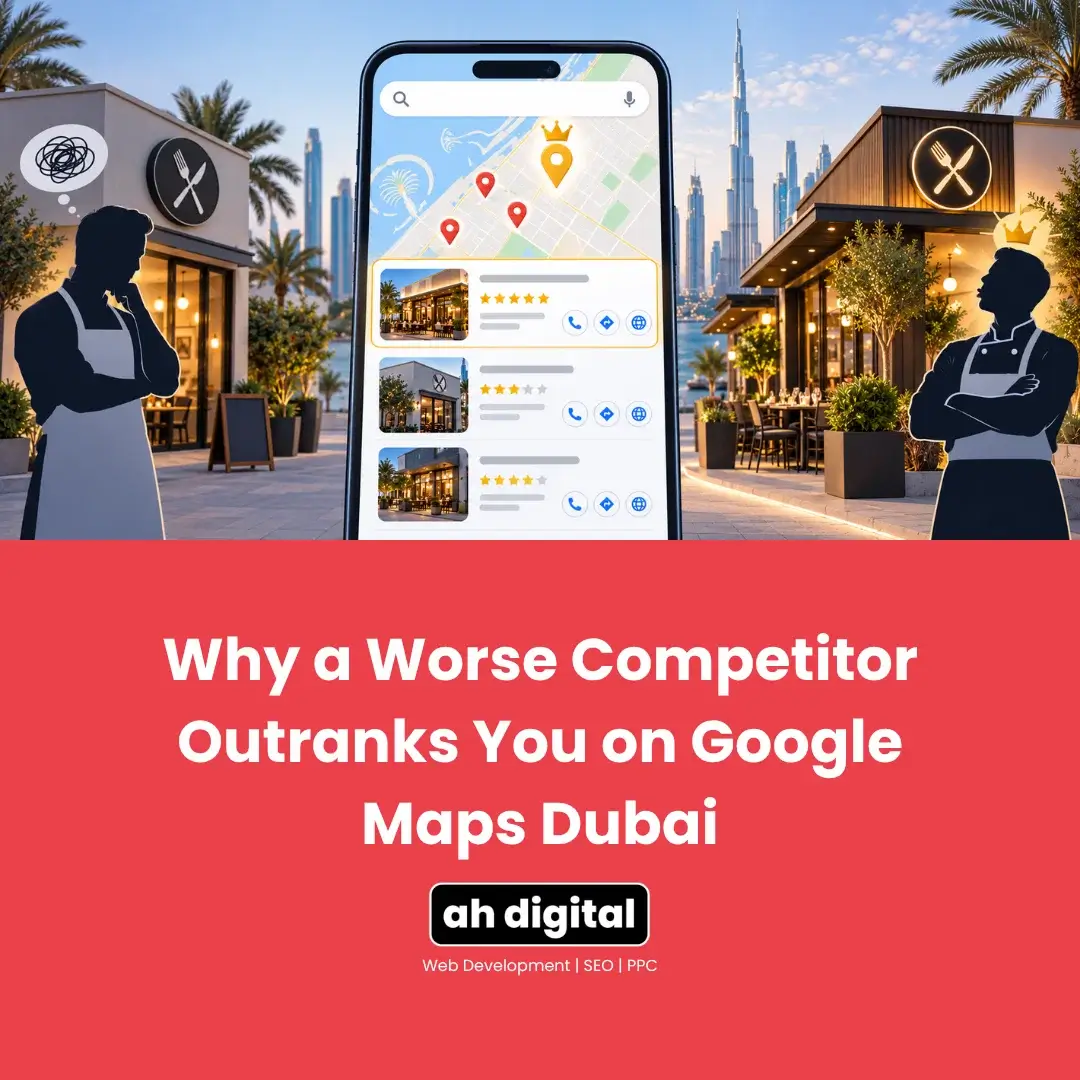
Your food is better. Your service is faster. Your reviews, read honestly, sound more genuine than theirs.
They still show up above you when someone searches nearby.
This is one of the most common frustrations UAE business owners raise, and the instinct is to assume the ranking is broken, or rigged, or simply unfair. It is usually none of those. It is following rules that are public, just rarely read.
Here is what actually decides who wins the Map Pack, why “better business” is not one of the inputs, and what is genuinely worth fixing.
Google Tells You Exactly How This Works
The Three Factors, In Google’s Own Words
Google is not vague about this. Its own guidance states plainly that local results are based mainly on relevance, distance and prominence.
Relevance is how well your profile matches what someone typed. Distance is how far you are from the person searching. Prominence is how well known and trusted your business appears, both on Google and off it.
None of the three factors is “quality of the business.” That is not an oversight. Google has no reliable way to measure your food or your workmanship directly. It measures signals that correlate with quality, imperfectly, and those signals are what you are actually competing on.
Why This Framing Matters
Once you separate the three, the mystery mostly disappears. A competitor outranking you is not one unexplained advantage. It is doing better on one or more of exactly three specific things, and two of them are things you can change starting today.
Distance: The One You Cannot Fix
It Is Simply Physical Proximity
Distance means exactly what it sounds like. How close your business is to wherever the person searching happens to be standing or typing from.
A competitor two streets closer to a cluster of your ideal customers starts every relevant search with a real advantage. No amount of profile optimisation closes that gap, because it is not a signal you are sending, it is a fact about geography.
Why This Should Change How You Spend Your Time
Since distance cannot be influenced, spending energy resenting it is wasted energy. The two remaining factors, relevance and prominence, are where every hour of effort actually pays off. That reframing alone changes what most owners should be doing differently.
Relevance: Decided Mostly By One Dropdown Menu
Your Primary Category Carries More Weight Than People Expect
Relevance is about how well your profile matches the search itself, and the single strongest signal you control here is your primary category.
Not your business name. Not your description, however well written. The category, selected from a dropdown, often months or years ago, sometimes chosen quickly without much thought about how it would be interpreted.
The Mistake That Quietly Costs Visibility
A restaurant categorised as “Restaurant” when it should be “Italian Restaurant” is invisible for the exact searches it should be winning. A cleaning company under a generic “Cleaning Service” category loses to a competitor specifically categorised as “Carpet Cleaning Service” for that precise search, even with a worse team.
Go back and check yours. This takes five minutes and is one of the few changes with an outsized, direct effect on relevance.
Prominence: Where “Worse Business, Better Ranking” Actually Comes From
Direct answer: prominence rewards visible, ongoing trust signals, and a business can generate those regardless of whether it is genuinely the best option nearby.
Reviews Are Not Simply Counted
This is the part that trips up business owners who compare review totals and conclude the ranking makes no sense. The 2026 edition of Whitespark’s Local Search Ranking Factors report, an annual survey of around 47 local search specialists scoring roughly 187 individual factors, again places review signals and behavioural signals among the categories that grew in weight for 2026.
The practical meaning: a business adding a steady trickle of recent, specific reviews can outrank a competitor whose larger total stopped growing two years ago. Recency and consistency now carry more of the load than the raw number ever did.
Responding to Reviews Is Part of Prominence Too
A profile that replies to reviews, including the critical ones, signals an actively managed business. One with the same review count and no replies at all reads, to both customers and to Google, as abandoned.
This is one of the lowest-effort, highest-visibility fixes available. If nobody has responded to a review in months, that is worth changing this week, not eventually.
Off-Site Trust Counts As Well
Prominence also draws on signals beyond your own profile: consistent citations across directories, mentions from local publications, genuine links from other UAE sites. A locally relevant link or mention still carries more weight for prominence than a generic international one, because it is harder to fake and harder for a competitor to simply copy.
The Honest Version of “Worse Business, Better Ranking”
It Is Rarely One Big Thing
Put together, the pattern behind most confusing rankings looks like this. The competitor is not closer by much, if at all. They picked a more specific, more accurate category at some point. And someone on their team, possibly without framing it as SEO at all, makes a habit of asking satisfied customers for a review and replying to the ones that come in.
None of that requires the business to actually be better. It requires someone to be doing three unglamorous, checkable things consistently.
What To Check This Week
Confirm your primary category is the most specific accurate option available, not the broadest one that seemed safe. Look at how many reviews arrived in the last 30 days versus the 30 days before that. And check whether recent reviews, especially critical ones, have a reply from the business.
If a rival is genuinely closer to your customers, that part is not fixable and is not worth dwelling on. If they are winning on category accuracy or review activity, both of those are entirely within reach, starting today.
Two Emirates, Two Different Fights
Ranking Well in Deira Does Not Mean Ranking Well in Marina
Because distance is measured from the searcher, not from your registered address, the same business can dominate one part of Dubai and be invisible ten kilometres away. This surprises owners who assume a strong ranking is a single, stable fact about their business.
It is not. It is a different competition in every neighbourhood, decided fresh for every search.
What This Means If You Serve the Whole Emirate
If your customers are spread across Dubai rather than clustered near one address, relevance and prominence have to work harder to compensate for the parts of the city where distance is working against you. A specific category and an active review habit close more of that gap than either one alone.
For a service-area business without a single fixed address, how the service area itself is configured becomes part of this same equation, not a separate setting.
The Bottom Line
A worse business outranking you is not a broken system. It is usually a business doing better on the two factors that are actually within anyone’s control, while distance quietly decides the rest.
Fix the category if it is vague. Build a habit of asking for reviews rather than hoping they arrive. Reply to the ones you already have. None of this is complicated, and that is precisely why it gets skipped.
If you want an honest read on where your profile is actually losing ground rather than guessing, our Google Business Profile management service audits exactly this.
WhatsApp Hameed for a quick question, or call +971 56 544 6241 for a free consultation. There is also a contact form if you would rather write it out.
The business that shows up first is rarely the best one. It is the one that made itself easiest for Google to trust.